
Usually yes — through workers compensation. When your own technician is exposed to a chemical on the job and is hurt, comp is the line built to respond, because a work-related injury to an employee is exactly what it answers for, with medical care and a share of lost wages. This guide walks why the exposure to your worker is comp’s, the critical line between that and a customer’s exposure, and the four states where comp works differently.
The single most important thing to get right is who was harmed. Your technician’s exposure is workers compensation. A customer’s or a neighbor’s exposure to the same product is a different policy. Below is the narrow question answered in full, kept strictly to the employee, with the third-party side left to the line it belongs on.
The short answer: usually yes, comp covers your technician
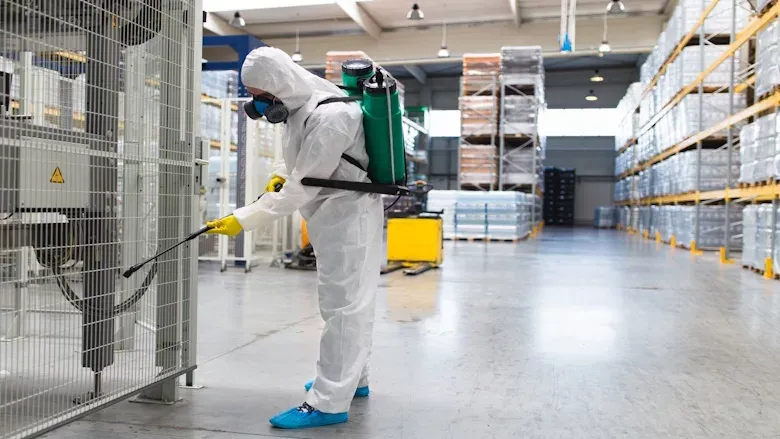
A tech takes a splash mixing concentrate, breathes fumes on a fumigation job, or gets product on skin during an application and is hurt. That is a work-related chemical exposure to your own employee — and that is exactly the first-party injury workers compensation is written to answer. Comp responds with medical treatment, a portion of lost wages while the worker recovers, disability benefits, and in the worst case death benefits to a family. It is the single line that covers your crew across the whole pest control injury profile — chemical exposure alongside ladder falls, crawlspace injuries, repetitive strain, and route driving. The honest qualifier is narrow on the coverage itself: the person hurt has to be your employee, and the exposure has to arise out of the work. On those terms comp responds. The two real complications are not about whether comp covers your tech — it does — but about keeping a third party’s claim on its own line, and about four states where comp comes only from a government fund.
The critical distinction: your worker versus a third party
This is the line operators most need to hold, because routing a chemical-exposure claim to the wrong policy gets it denied. The product is the same; the policy is not. Harm to your own technician is workers compensation — first-party coverage for your crew, paying medical care and lost wages regardless of fault. Harm to a customer, an occupant, or a neighboring property from the same product is a third-party claim, handled by general liability and, for the chemical and environmental side, pollution liability. The same incident can touch both lines at once — a fumigation job goes wrong and both a tech and an occupant are affected — and when it does, comp answers for the worker while pollution liability answers for the third party. They are kept separate because they cover different people, not because the loss is different. This post stays strictly on the worker. The customer’s side is its own question, walked in is a customer’s chemical-exposure claim covered. An operator who assumes one policy reaches both can find the technician’s injury and the customer’s claim each pointed at a policy that was never written to answer it.
Real-World Scenario: A technician mixing concentrate at the truck takes a splash to the face and arm and is taken for medical treatment, missing several weeks of work. The exposure happened on the job, to the operator’s own employee, so it is reported as a workers compensation claim — comp covers the medical care and a share of the lost wages while the tech recovers. If, on that same job, drifting product had also reached a neighbor’s yard and someone there reported a reaction, that part would not be comp at all; it would be a third-party matter for pollution liability. The operator who keeps both lines in force has a policy for each half. The one who carried comp but skipped pollution liability has the worker covered and the neighbor’s claim stranded.
What comp covers and where it stops
Comp is built to respond to your own employees’ work-related injuries and illnesses: medical treatment, a portion of lost wages, disability benefits, and death benefits. For chemical exposure specifically that means the acute event — a splash, a spill, an inhalation, skin contact during mixing, application, or fumigation — and it can also reach occupational illness, a condition that develops from repeated exposure over time. How an occupational-disease claim is proven and handled varies by state and can be more complex than an acute injury, so the specifics turn on state law and the facts; the principle is that harm to your employee arising out of the work is comp’s to answer.
Where comp stops is just as important. It does not cover third parties — a customer or neighbor harmed by the product is general liability and pollution liability, not comp. It does not cover the vehicle in a route crash — that is commercial auto. And it does not cover your sprayers, rigs, or stored product — that is commercial property and equipment. Each line answers for different people and property, which is why a pest control operation carries comp alongside the others rather than assuming one stretches to cover the rest.
What actually responds, and the four-state exception
On a clean exposure to your own technician, your workers compensation coverage responds — the medical care and lost-wage benefits flow under the policy or the state fund, largely on terms set by each state’s statute rather than chosen the way you pick a liability limit. The structure that matters for a pest control operation is getting your field technicians classified to the work they actually do, scheduling the states your crew works in, and adding an other-states provision for work you pick up. There is one hard exception worth being exact about: in four monopolistic states — North Dakota, Ohio, Washington, and Wyoming — private insurers cannot write comp at all, and coverage comes only through each state’s own government fund: Workforce Safety and Insurance in North Dakota, the Bureau of Workers’ Compensation in Ohio, the Department of Labor and Industries in Washington, and the state-administered fund in Wyoming. These are government programs, not private carriers. For an operator with a tech exposed to a chemical in one of those four states, the consequence is concrete: a private policy from elsewhere does not respond, and the coverage has to come through the state fund. The full treatment of how comp is structured for multi-state crews lives on the workers compensation page; the point for the exposure question is that comp answers your worker — but in those four states, only through the fund.
A practical check before the next mixing cycle
Set this up before an exposure tests it. Carry workers compensation, classify your field technicians to the pest-control work they actually perform rather than a generic office or sales class, and schedule the states your crew works in with an other-states provision for the rest. Identify any of the four monopolistic states on your footprint and arrange coverage through that state’s government fund before the work starts, because a private policy will not respond there. Keep the third-party side on its own line — carry pollution liability so a customer’s exposure has a policy too. And run the worker-safety basics that both prevent the exposure and support a claim: the standard for handling, mixing, and applying product sits under the EPA pesticide program and applicator standards under the EPA certification framework, and workplace chemical-safety practice under OSHA. A broker who knows the trade should map where your crew works and how they handle product before the policy binds.
Before it happens, cover the crew everywhere they work
A chemical exposure to your technician is the trade-defining first-party injury, and the operation that wants its crew covered carries comp structured for every state they touch — including the four where it comes only from a government fund. Carry workers compensation, classify the crew correctly, schedule the states, handle the monopolistic-state placements, and keep pollution liability alongside it so the third-party half of a chemical incident is not stranded. The companion read for the customer’s side is is a customer’s chemical-exposure claim covered, and for the cleanup and regulatory angle, pest control insurance and EPA fines and cleanup costs. What comp costs depends on your payroll, classifications, and where you work — see the cost drivers behind it, and how it fits a fumigation operation with the heaviest exposure profile. When you are ready, start a quote and tell us where your crew works.