Insurance by operating model
General Pest Control Insurance for Pest Control Contractors
Insurance for the everyday recurring-service pest control operation — extermination, ongoing prevention, rodent control, and bed-bug treatment crews — structured around the on-site service-call, routine pesticide-application, and tech-in-the-field exposures that define a route-based operating model.
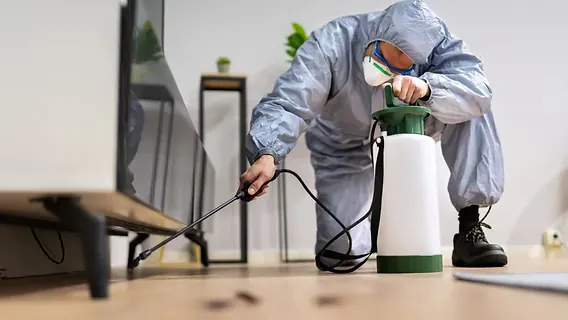

General pest control is its own operating model, not a coverage line — and the way a recurring-service crew works is what makes its insurance distinct. A general pest control operation runs a route: techs visit the same accounts on a recurring schedule, apply treatments, set and monitor stations, and solve problems on the spot. The work that lives inside this model is the everyday pest work — routine extermination, ongoing prevention, rodent control, and bed-bug treatment. It is steady, relationship-driven, and built on repeat visits to homes and businesses you treat over and over. That is a very different risk picture from a tented fumigation job or a termite warranty, and it demands a program built around the route and the service call.
Three exposures define the model and concentrate the risk. The first is the on-site service-call exposure — your tech is physically present at a customer’s property, walking a freshly treated or wet floor, moving through occupied space, and handling property along the way, which is a third-party general liability exposure on every visit. The second is the routine pesticide-application exposure — the everyday act of applying product can drift onto a neighboring property, be misapplied, or expose an occupant or bystander, and that chemical loss is a pollution condition the standard general liability form excludes, which is why pollution liability is a signature placement for this model. The third is the tech-in-the-field exposure — your techs drive the route, handle chemicals, climb ladders, and work attics and crawlspaces, an injury profile that runs through workers compensation.
On top of those three, the model carries the realities of running a service fleet and a chemical-handling business. Truck-mounted rigs, sprayers, and gear travel between accounts every day and sit on the truck overnight. The crew that runs the route frequently lives in one state and services accounts in another. And the commercial accounts that anchor a recurring book — property managers, food-service clients, healthcare and institutional facilities — attach insurance, limit, and additional-insured requirements an operation has to meet to keep the work.
This page covers how general pest control insurance is built as a whole: what the recurring-service model is and the work it covers, the service-call and application risk profile, the full coverage stack the model needs, the drivers that move cost, and how carriers underwrite a route-based operation. If your work is fumigation or termite-led instead, the Fumigation Insurance and Termite & WDO Insurance pages are built for those models.
Running a recurring pest control route? Get a quote structured around your accounts, your application work, and the techs in the field.
Get a Free QuoteWhat makes general pest control insurance different
General pest control risk is route-and-application risk, and it lands hardest on three coverage lines in a way a generic contractor form does not anticipate. General liability carries the on-site weight, because your techs are in customer space on every visit and the slip, the property damage, and the third-party incident at an account are the everyday exposure. Pollution liability carries the chemical weight, because routine application that drifts, is misapplied, or exposes an occupant is the loss the standard general liability form excludes — the signature seam of any applicator operation. And workers compensation carries the field weight, because a tech driving the route and handling chemicals is exposed all day. A policy rated to a generic service business treats none of these with the emphasis a pest control operation needs.
The practical consequence is that two pest control operations with similar revenue can carry very different exposures depending on what the route actually does. A crew running heavy chemical application near sensitive accounts looks nothing like a crew doing light monitoring and exclusion work — and writing both off one form underprices the application exposure and strands the pollution risk. We separate the general pest scope from any fumigation or termite work in the same book so neither is mispriced, and we weight the stack toward the lines this model leans on.
The work this covers
The recurring-service model holds several kinds of work that share one risk profile — a tech on site, a product applied, and a customer relationship that repeats. These are the services that live within this pillar rather than standing on their own:
- Pest extermination. The core treatment work — knocking down an active infestation of ants, roaches, spiders, wasps, or other general pests at a customer account, the everyday application that anchors the route.
- Ongoing pest prevention. The recurring maintenance visits — perimeter treatments, monitoring, and exclusion work on a schedule — that turn one-time jobs into the repeat accounts a route is built on.
- Rodent control. Trapping, baiting, exclusion, and sanitation work for mice and rats, including the station placement and monitoring that runs alongside the treatment route.
- Bed-bug treatment. Inspection and treatment work — chemical, heat, or a combination — in occupied residential and commercial space, where the occupant-contact and treatment-efficacy exposures sit close together.
Fumigation and termite or wood-destroying-organism work are not part of this model — they carry their own signature exposures and live on the Fumigation Insurance and Termite & WDO Insurance pages. If your operation runs more than one of these models, each scope is underwritten on its own terms.
State and regulatory considerations
General pest control sits at the intersection of pesticide regulation, applicator licensing, and worker safety — and the rules vary by state. The federal floor is the U.S. EPA pesticide program under FIFRA, which governs how pesticides are registered, labeled, and used — and the label is the law your techs apply by. Applicator certification flows from that framework through the EPA applicator-certification program, but the licensing itself is a state-by-state patchwork — most often run by a state department of agriculture, sometimes by a structural pest control board or commission. Worker safety on the route, including chemical handling and hazard communication, runs through OSHA standards.
On top of the federal layer, workers compensation rules vary by state — including the four monopolistic states where coverage comes only from the state fund, which matters for a crew that runs a route across state lines. As our state pages come online we link the applicator-licensing, regulatory, and damage-prevention specifics for the states we serve. Pest pressure and pest control activity concentrate in warm, humid regions, so Tier-1 markets include states such as Texas, Florida, Georgia, North Carolina, and California, and we write across all 48 licensed states.
Coverage breakdown
Here is the stack a general pest control operation carries, weighted for the recurring-service model. Each line links to its full page — and the three that carry the most weight, general liability, pollution liability, and workers compensation, are the signature placements.
- General Liability Insurance — a signature line: third-party bodily injury and property damage from the on-site work at your accounts, the slip on a treated floor, and the public-facing exposures of a service route. The general liability page covers the mechanism in full.
- Pollution Liability Insurance — the signature applicator line: drift, overspray onto a neighboring property, misapplication, occupant chemical exposure, and environmental cleanup — the loss general liability flatly excludes.
- Workers Compensation Insurance — a signature line: medical and lost-wage coverage for techs handling chemicals, driving the route, and working ladders and crawlspaces, structured for the multi-state reality of a traveling crew.
- Commercial Auto Insurance — the trucks and service-route fleet your techs drive every day, the mounted tanks, the daily-stop accident exposure, and the gear in transit.
- Commercial Property & Equipment Insurance — the shop, office, and stored chemical inventory you run from, plus inland-marine coverage for the truck-mounted rigs, sprayers, and tools moved between accounts.
- Professional Liability Insurance — errors-and-omissions coverage for a faulty inspection or a treatment-efficacy dispute that causes a financial loss without bodily injury or physical damage.
- Umbrella Liability Insurance — excess limits above general liability and commercial auto for larger operations and the higher limits commercial accounts and larger contracts often require.
What general pest control insurance costs
Premium tracks the route, not a sticker price. The drivers that move it most are your payroll and the technician classifications it covers, how much of your scope is general pest work versus fumigation or termite work, the products and methods your crews apply and how close they work to sensitive accounts, the size and value of your truck-mounted rigs and fleet, the mix of residential and commercial accounts you service, the limit and additional-insured requirements your commercial contracts impose, your multi-state footprint, and your claims history. A crew running heavy chemical application near occupied and sensitive accounts looks very different to an underwriter than one doing light monitoring and exclusion work. We price to that real picture and stand behind any figure we give — verified ranges come from us directly, never a generic guess.
Claims scenarios
These are plausible general pest control claim categories, described qualitatively and with generic carrier language — every claim is handled by the carrier, never named here — and with no fabricated cost or frequency figures.
- Pesticide drift onto a neighboring property. A routine treatment drifts or overspray reaches an adjacent yard, garden, or water source — the chemical loss most specific to an applicator operation, where general liability’s pollution exclusion typically pushes the exposure to pollution liability.
- Misapplication or occupant chemical exposure. A product is misapplied at an account, or an occupant or bystander is exposed during a treatment — a pollution-driven claim with a third-party injury element.
- A slip or property-damage incident at an account. A customer slips on a treated or wet floor, or your tech damages property during a service call — the everyday on-site general liability exposure of recurring route work.
- A tech injured on the route. A field injury — a fall from a ladder, a chemical-handling incident, or a vehicle accident driving the route — the signature workers compensation exposure of a route-based crew.
Underwriting realities
Carriers writing the general pest control class look at the route and the chemistry: payroll and technician classifications, the products and methods your crews apply, how close you work to sensitive and occupied accounts, your applicator-licensing and training discipline, your fleet and where the gear is stored, your subcontractor controls, and your loss history. Documented applicator certification, label-compliant application practices, strong subcontract and certificate discipline, and a clean drift and misapplication history open more markets; a serious application or chemical-exposure loss narrows them. Operations that also run fumigation or termite divisions get those portions underwritten separately so the general pest route is not subsidizing — or stranding — the rest of the book. We position your operation to the carriers most likely to want a recurring-service pest control risk rather than sending one generic submission everywhere.
Why Pest Control Guard Insurance
We write one trade — commercial pest control contractors — and within it we treat general pest control as the route-based, application-exposed operation it is. We weight your stack toward the general liability, pollution, and workers compensation exposures a recurring-service crew actually carries, read the pollution wording against the products and methods your techs apply rather than assuming it away, schedule the truck-mounted rigs and gear that travel the route, structure workers compensation for a crew that crosses state lines, and set the subcontractor and additional-insured requirements that keep a sub’s misapplication off your policy. We place coverage with carriers that want the pest control class. Start with a quote, or send us a commercial account’s insurance requirements and we will tell you what limits and coverage it requires.
Learn more
General pest control is one of three pest control operating models, and the coverage stack shifts with the work. The signature exposures for this model live on the general liability, pollution liability, and workers compensation pages. If your work is fumigation or termite-led, the Fumigation Insurance and Termite & WDO Insurance pages are built for those models — and the pest control insurance services overview explains how the three differ.
Coverage for general pest control operations
- General Liability Insurance
- Commercial Property & Equipment Insurance
- Workers Compensation Insurance
- Commercial Auto Insurance
- Pollution Liability Insurance
- Umbrella Liability Insurance
- Professional Liability Insurance
Pest control specialties
Get covered
Primary sources
Frequently asked questions about General Pest Control Insurance
What insurance does a general pest control company need?
A recurring-service pest control operation typically carries general liability, pollution liability, workers compensation, commercial auto, commercial property and equipment, professional liability, and an umbrella as its core stack. The weight sits on three lines: general liability for the on-site work at your accounts, pollution liability for the everyday pesticide-application exposure that general liability excludes, and workers compensation for techs running the route. We build the stack around the way your crews actually service accounts rather than rating you off a generic contractor policy.
Why does a routine pest control operation need pollution liability?
Because the everyday work is chemical application, and the policy an operator assumes will respond is the one form written to exclude it. When a routine treatment drifts onto a neighboring property, a product is misapplied, or an occupant or bystander is exposed, the resulting claim is a pollution condition — and the standard general liability form carries a pollution exclusion that typically bars the chemical-exposure and cleanup portion. Pollution liability, sometimes written as applicator or contractors pollution coverage, is the separate line that fills that gap. It is one of the signature placements for a pest control operation, which is why we treat it as central rather than optional. The pollution liability page covers the mechanism in full.
Does general liability cover pesticide drift onto a neighboring property?
Often only partly, and that is the trap. General liability may respond to some third-party bodily injury or property damage tied to your work, but its pollution exclusion typically bars the chemical-exposure, drift, and environmental-cleanup portion — which is exactly the part of a drift or overspray incident that drives the loss. That gap is why pollution liability exists and why we place it alongside general liability for a routine application operation rather than assuming the standard form will answer. We read the wording against the products and methods your crews actually apply.
How does workers comp work for pest control techs who drive a route across state lines?
It is one of the trickier parts of running a route-based operation that crosses borders. When a tech lives in one state and services accounts in another, workers compensation has to account for payroll earned across state lines, extraterritorial and reciprocity rules, and the four monopolistic states where coverage comes only from the state fund. The field injury profile of a pest control tech — chemical handling, driving the route, ladders, attics, and crawlspaces — makes a comp gap especially serious. We structure workers compensation for the multi-state reality of a traveling service crew rather than a single home base.
Are my truck-mounted rigs, sprayers, and equipment covered if they are stolen?
That is what the commercial property and equipment line is built for. Your truck-mounted tanks and rigs, sprayers, bait and monitoring gear, and the tools that move between accounts are a known theft and damage target, and the loss can be severe. Commercial property and equipment coverage — which combines property for your shop, office, and stored chemical inventory with inland-marine coverage for the gear in transit and on the truck — is built to respond to theft and damage where the equipment travels and sits, subject to the policy terms. We confirm how the form treats equipment on the truck and at remote accounts before you bind.
Do my pest control subcontractors need their own insurance?
Yes, and on recurring service work it matters more than operators expect. If you sub out treatments or route coverage, a subcontractor’s misapplication, drift, or on-site injury happened under your account and your service agreement, so the loss can roll up onto your general liability and your pollution exposure. The standard discipline is written subcontract agreements, certificates of insurance confirming each sub carries its own general liability and pollution coverage, and additional-insured status flowing up to you. We help you set those requirements so a sub’s application loss does not become yours.
Does general pest control insurance also cover my fumigation or termite work?
Not automatically, and that is by design. General pest control is the recurring-service operating model — extermination, prevention, rodent, and bed-bug work. Fumigation and termite or wood-destroying-organism work are genuinely different operating models with their own signature exposures: fumigation carries a gas and occupant-safety profile, and termite or WDO work carries a professional-liability risk tied to inspections and treatment guarantees. If your operation does any of that work, the fumigation and termite or WDO pillar pages are built for it, and we structure those scopes deliberately rather than folding them into a general pest policy.
Why do commercial accounts and larger contracts drive my insurance requirements?
Commercial accounts — property managers, food-service and hospitality clients, healthcare and institutional facilities — frequently require liability limits, additional-insured status, and certificates of insurance broader than a primary policy carries on its own. An umbrella is the efficient way to reach the liability limits, and the right general liability and pollution limits satisfy the application and on-site requirements those accounts trigger. When a contract specifies requirements you do not currently meet, that is usually the conversation, and we size the program to the requirement rather than quote a number.
Insure your pest control route the way your crew runs it
Tell us about your accounts, your application work, and the techs in the field, and we will market it to carriers that write the pest control class.